




Driving Strategic Transformation Through Technology Leadership
Technology as a Catalyst for Business Transformation
In today’s complex enterprise environments, technology leaders are no longer confined to managing infrastructure or optimizing systems — they are at the forefront of enabling business transformation. At Secloudis, we help organizations harness the full potential of modern technologies to align IT initiatives with strategic business outcomes.
From redefining operating models to unlocking digital acceleration, we support enterprises in navigating disruption with confidence and clarity. Our expertise spans strategy, governance, data ecosystems, and innovation — ensuring that technology investments translate into sustainable value and competitive advantage.
Artificial intelligence, and particularly deep learning through neural networks, plays a key role in this transformation. These technologies can process massive volumes of data, recognize intricate patterns, and deliver predictive insights at scale. When integrated into business processes, they open new horizons: personalized customer experiences, optimized operations, smarter decision-making, and the ability to anticipate rather than react.
At Secloudis, we view AI not as a standalone solution, but as a strategic enabler — embedded across platforms, workflows, and decision layers to help organizations drive growth, resilience, and innovation.
What We Deliver
- Technology Strategy & Roadmap
We help CIOs articulate a forward-looking technology vision that aligns IT capabilities with business growth, operational efficiency, and resilience objectives. - IT Governance & Risk Management
From regulatory compliance to cybersecurity frameworks, we establish governance models that foster accountability, risk awareness, and strategic oversight across the IT landscape. - Organizational & Operating Model Design
We design modern IT operating models that promote agility, scalability, and value delivery — covering talent, sourcing strategies, and digital ways of working. - Innovation & Change Leadership
We guide the integration of emerging technologies — including Generative AI — and support CIOs in orchestrating enterprise-wide transformation and cultural adoption.
Our Differentiators
- Cross-functional Expertise
We seamlessly bridge business strategy, data ecosystems, cloud platforms, and AI transformation to maximize end-to-end value. - Executive Mindset
We engage at the C-suite level, enabling CIOs to translate tech priorities into boardroom influence and enterprise impact. - Results-Oriented Delivery
We combine strategic insight with execution excellence — delivering tangible outcomes from roadmap to realization.
Ideal for
- Enterprises seeking to realign IT with business value
Organizations ready to reposition IT as a driver of measurable growth, customer value, and competitive differentiation. - CIOs leading complex enterprise transformations
Leaders preparing for major shifts such as mergers & acquisitions, generative AI adoption, or enterprise-wide cloud modernization. - Companies transitioning to agile digital delivery models
Teams moving beyond legacy structures to embrace product-centric, data-driven, and scalable IT operating models.
how it worksWhat CIOs Need to Know
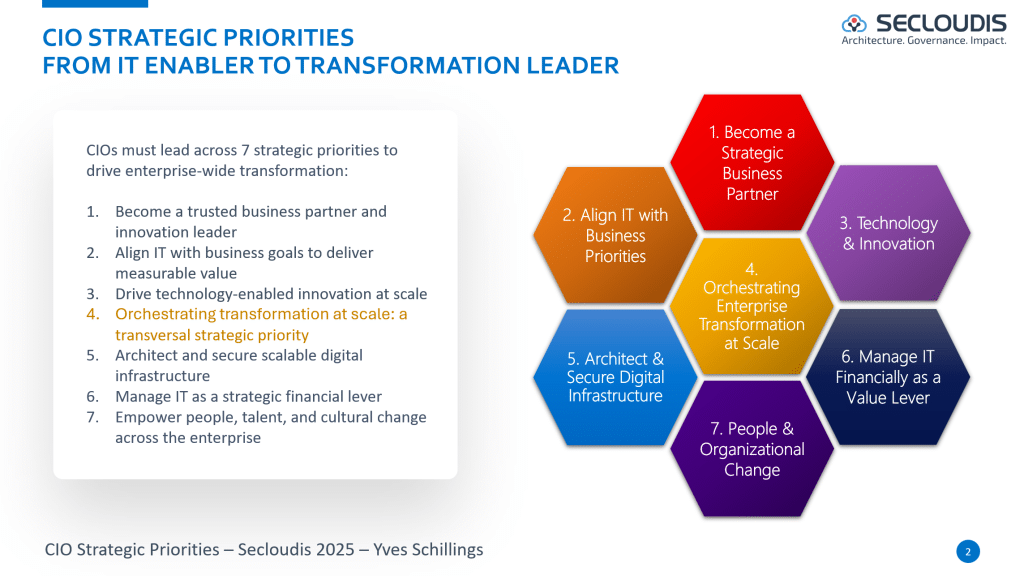
📘 CIO Strategic Priorities – Secloudis 2025
To elevate IT beyond its traditional support role, today’s technology leaders must champion value creation at the heart of the business. This requires a shift from operational service delivery to measurable strategic impact.
CIOs need to co-own business KPIs, aligning IT initiatives directly with growth, profitability, and customer outcomes. IT should be embedded in product innovation, go-to-market strategies, and revenue-generating activities — not just back-office optimization.
This evolution also means reframing the CIO’s role: from cost controller to strategic orchestrator, capable of translating business ambition into technology execution and vice versa.
CIOs should lead with value — framing technology as a strategic enabler, not just a cost center.
To enable enterprise agility and responsiveness in a rapidly changing landscape, CIOs must shift from rigid legacy structures to modular, product-centric operating models. This evolution is not just technological — it’s organizational.
Modern IT operating models are built on composability: hybrid cloud architectures, data-centric platforms, API-first ecosystems, and dynamic sourcing strategies that adapt to business needs in real time. These foundations empower teams to deliver faster, scale smarter, and innovate continuously.
CIOs must also instill platform thinking — where IT is not a silo, but a set of shared capabilities that accelerate product delivery, customer experience, and cross-functional collaboration.
CIOs should structure IT around reusable and scalable capabilities that accelerate transformation across teams and functions.
CIOs have a critical role to play in moving beyond isolated pilots and tech-driven experimentation toward enterprise-wide enablement. The real value of GenAI and emerging technologies lies not in novelty, but in scalable integration — across workflows, products, and decision-making layers.
To lead this shift, CIOs must establish robust ethical governance frameworks, ensure data integrity, and anticipate regulatory challenges. At the same time, they need to evolve IT operating models to support experimentation at scale — balancing innovation speed with enterprise risk posture.
Upskilling the workforce is also essential. CIOs must champion AI literacy, cross-functional collaboration, and a culture of responsible innovation that empowers employees to harness AI in meaningful, value-driven ways.
CIOs should move beyond isolated AI experiments and focus on integrating these technologies at scale — supported by strong governance, practical enablement, and the right internal capabilities.
Trust at the top begins with clarity, credibility, and strategic relevance. CIOs must go beyond technical reporting to speak the language of the board — framing technology initiatives in terms of business outcomes, opportunity costs, and enterprise risk.
This requires transparency in how IT investments are prioritized, how risks are assessed and mitigated, and how progress is measured against goals that matter to executive stakeholders. CIOs should align transformation KPIs with strategic imperatives — growth, resilience, customer value — not just system uptime or budget adherence.
By consistently linking technology to business value and demonstrating foresight in risk management, CIOs can position themselves as indispensable partners in shaping enterprise direction.
CIOs earn board trust by translating technology into strategic insight — and delivering results that matter.