




Data Governance is the safeguard of enterprise intelligence
Ensuring data quality, accountability, and compliance across the information lifecycle
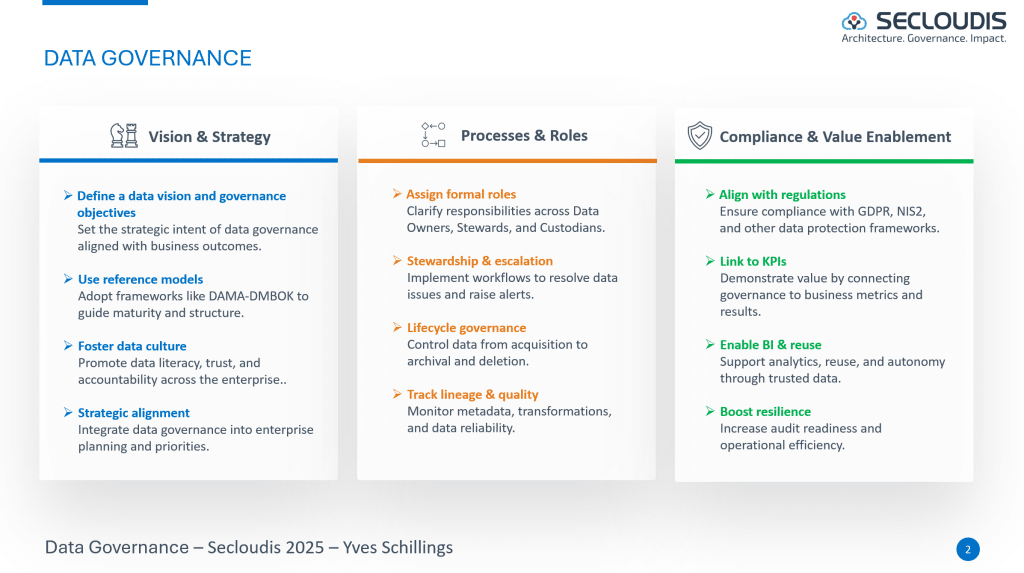
In the age of AI and analytics, having data is not enough — organizations need to trust their data. Data Governance defines the people, processes, and policies that ensure data is accurate, secure, and responsibly used. Whether for regulatory compliance, operational reporting, or machine learning, governed data enables organizations to make decisions with confidence and integrity.
A robust governance framework brings together legal, IT, and business stakeholders to manage data as a strategic asset — from lineage to access rights, from classification to ethics.
What We Deliver
Data Governance Strategy & Framework Design
We define clear governance models, stewardship roles, and policies aligned with business and regulatory needs.Regulatory Compliance & Risk Mitigation
We help ensure ongoing compliance with frameworks such as GDPR, HIPAA, and DORA while mitigating data-related risk.Data Quality & Metadata Management
We implement tools and practices to manage data lineage, cataloging, and quality across the enterprise.Operating Model & Stewardship Network
We support the setup of federated governance models with defined responsibilities across domains and business units.
Our Differentiators
End-to-End Alignment
We integrate governance from data sourcing to AI, reporting, and business workflows.Technology-Agnostic Approach
We work with any governance stack (Microsoft Purview, Collibra, Informatica, etc.) — always focusing on results.Business-Embedded Governance
We embed governance practices into operational flows — making compliance effortless and data usable.
Ideal for
Organizations dealing with fragmented, siloed, or non-compliant data
CIOs or CDOs leading data transformation or preparing for AI readiness
Enterprises subject to regulatory and audit requirements
Data teams aiming to enforce ownership, trust, and data value chain transparency
how it worksWhat CDOs Need to Know
To unlock the true value of data, CDOs must elevate it from a technical byproduct to a core business asset. This requires aligning data initiatives with enterprise objectives, creating a shared understanding of data value, and embedding data ownership across the organization. A mature data governance framework provides the foundation for accountability, stewardship, and business-driven KPIs.
Treating data as capital requires governance that speaks the language of business, not just IT.
Enterprise data governance rests on four key pillars:
Data Ownership & Accountability
Data Quality & Standards
Access Control & Privacy Compliance
Metadata & Lineage Transparency
These components must be operationalized through clear roles, consistent policies, and adaptive processes. Scalable governance leverages automation, collaborative workflows, and self-service capabilities.
Without these pillars, data becomes a liability — not a lever of growth.
Data governance is central to managing legal, ethical, and operational risks. Proactive CDOs integrate risk, compliance, and IT security teams to embed “compliance by design” into data pipelines. With increasing complexity from GDPR, AI Act, and ESG reporting, the governance model must support continuous auditability, traceability, and policy enforcement across hybrid environments.
Robust governance transforms regulatory pressure into competitive resilience.
Culture is the catalyst for governance success. CDOs must drive behavioral change by promoting data literacy, embedding governance into daily operations, and recognizing data contributions as part of business performance. Governance is no longer a constraint — it’s a facilitator of agile, confident, and insight-driven decisions.
You don’t build a data-driven company with tools — you build it with trust, literacy, and leadership.