





Structuring Business Transformation Through Enterprise Architecture
Aligning capabilities, data, processes, and technology under a unified architectural vision.
In today’s complex digital landscape, organizations can no longer afford fragmented systems and disconnected strategies. Enterprise Architecture (EA) provides the blueprint for aligning business goals with IT capabilities, ensuring coherence across operating models, applications, data, and infrastructure.
At Secloudis, we help enterprises move beyond static frameworks. Our EA approach is agile, actionable, and focused on enabling transformation — whether driven by AI adoption, cloud modernization, regulatory needs, or operational excellence.
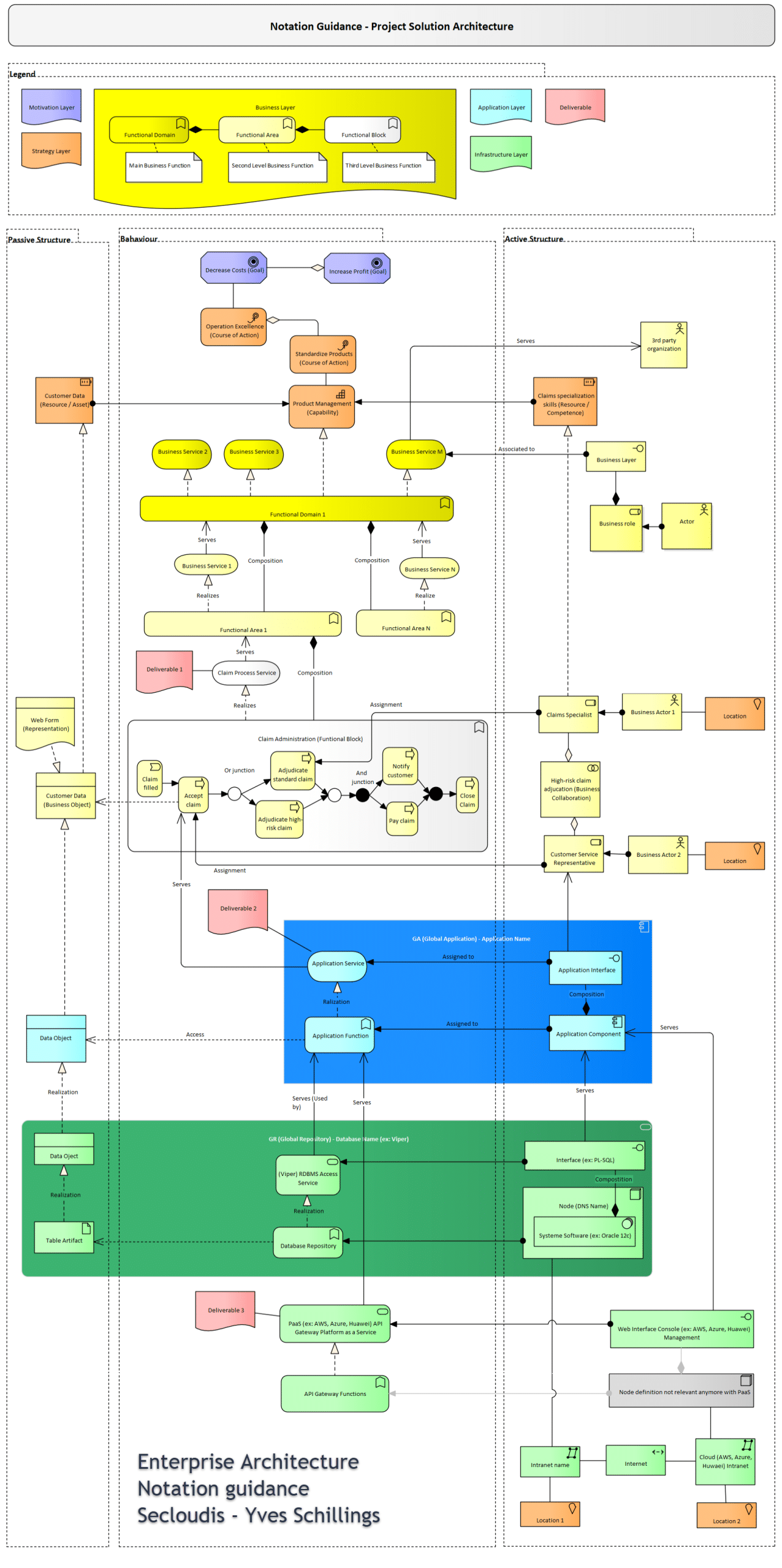
What We Deliver
- Enterprise Architecture Strategy & Frameworks
We define architecture principles, layered models, and capability maps aligned with business strategy and innovation goals. - Target Operating Model & Transformation Roadmaps
We design TOMs that link business processes, data, applications, and platforms — supported by structured migration paths. - Reference Architectures & Solution Alignment
We provide reusable patterns and blueprints across domains (data, cloud, security, integration, AI…) to guide scalable solution design. - Architecture Governance & Stakeholder Enablement
We help establish architecture boards, review processes, and tooling for alignment across teams and programs.
Our Differentiators
- Business-Driven Architecture
We connect strategy and execution — not just technical layers — by focusing on capabilities, value streams, and operating model coherence. - Cross-Domain Coverage
Our architects work across AI, cloud, data, integration, and security to design unified, future-ready architectures. - Pragmatic and Agile EA
We avoid documentation overload and focus on architecture that supports change, iteration, and measurable outcomes.
Ideal for
- Enterprises undergoing large-scale transformation or preparing for AI, cloud, or platform modernization.
- CIOs, CTOs, and Heads of Transformation needing architecture discipline without bureaucracy.
- Organizations looking to improve cross-functional alignment and reduce architectural debt.
how it worksWhat Leaders Need to Know About Enterprise Architecture
In an age where organizations are expected to deliver AI-driven innovation, migrate to the cloud, ensure regulatory compliance, and improve time-to-market — all at once — Enterprise Architecture becomes essential to maintain coherence. Without a unifying architectural view, initiatives risk multiplying in silos, duplicating effort, and failing to scale.
Enterprise Architecture provides the strategic lens to align disparate change programs with a cohesive vision of where the organization is going — and how it will get there, across systems, people, and data.
Modern transformation without architecture is like scaling a building without a blueprint — risky, chaotic, and unsustainable.
Contrary to its old reputation as a bureaucratic bottleneck, contemporary EA is a catalyst for speed and focus. By clarifying capabilities, exposing redundancies, and aligning roadmaps across teams, EA reduces delays caused by misaligned decisions and rework.
It enables reuse of proven architectural patterns, accelerates vendor selection, supports agile delivery through architecture sprints, and ensures that technology investments actually support strategic goals — not just technical fashion.
When embedded properly, architecture is a velocity enabler, not a governance overhead.
Today’s EA is dynamic, collaborative, and tightly coupled with delivery. It favors modularity over monoliths, capability-driven planning over abstract layering, and co-creation with business and IT stakeholders over top-down ivory tower control.
Rather than producing massive documentation for compliance’s sake, modern EA focuses on just-in-time artefacts, digital tooling, architecture as a service, and minimum viable governance — designed to support change, not resist it.
Modern EA trades static frameworks for adaptive ecosystems.
Architecture becomes truly valuable when it is embedded into governance mechanisms that shape real decisions — not just post-facto reviews. This means establishing architecture boards that are empowered (not ornamental), integrating EA checkpoints into agile ceremonies, and aligning architectural criteria with procurement, security, and investment decisions.
It’s also about creating a shared language between architects, delivery teams, product owners, and executives — so that architectural thinking scales with the organization.
Governed architecture isn’t about control — it’s about making better decisions, faster and together.